Showing posts with label economics. Show all posts

Wednesday, March 09, 2011

How history shapes people

We know that our history shapes our lives to some extent. What a new field of economics is finding is to just how large an extent that is.

Tim Harford
author of the excellent Undercover Economist wrote earlier on this year about the phenomenon:

The largest silver mines in the Spanish empire were the Potosí mines, discovered in 1545 in what is now Bolivia. Exploiting the mines was dangerous, and in the late 16th century, the Spanish introduced the mita system of forced labour. Villages near Potosí were obliged to provide one-seventh of their adult male population to work the mines, and the mita system continued until its abolition in 1812.

That is history. This is not: the former mita districts are 25 per cent poorer than apparently identical districts on the other side of a boundary that ceased to mean anything 198 years ago. A long-abolished colonial system has somehow shaped the modern world.

While the field is a relatively new one, it has profound implications for public policy. Circumstances determine much of people's lives, even where those circumstances linger in the mists of collective memory. Policies such as those being implemented in Brazil to create conditional cash transfers are perhaps one way of addressing these inherited inequalities, but more ways must be found. It is considered a classic example of injustice that a child ought not inherit the sins of their parent (or their parent's owner); we ought do more to make that a reality.

Sunday, September 21, 2008

A long way left to fall?

With the stock market withering like a plant in the desert sun, and commentators everywhere beginning to genuinely ponder the idea that the financial crisis could be as bad as the 1930's, it seems time to ask ''how bad is it going to get''?

I'm not an expert on stock markets by any means, but there is an interesting fact that could have relevance to today's crisis. The reason that people buy shares is, fairly evidently, for a share of the company's profits. In the long-term, shares need to give a higher return that the rate of interest in a bank. Otherwise, there'd be no reason to buy them in the first place. Historically, the rate of return on shares that the market has settled at means that people make their money back in 14.5 years, in other words an interest rate of 6.89%. That's a reasonable return, and enough more than putting your money in the bank to make the risk of buying shares worthwhile.


As the above graph shows, the prices at the moment are still well above that level. At the moment, the price of shares is around 25 times the annual earnings, or an interest rate of around 4%. Given that you can get a rate that's higher than that from a lot of banks' saving accounts, and the current market turmoil, there is every chance that share prices will continue to fall.


Notes: 1. I wrote this before the announced bailout, but think it is still relevant
2. The inspiration for this came from the Undercover Economist, a book I'd highly recommend

Tuesday, September 02, 2008

Bobby Kennedy

I've started an economics course before my masters, and we're studying GDP and GNP at the moment. I finished a wonderful book recently about Bobby Kennedy (about which more soon), but I couldn't help but share this quote, which I think reflects the inadequacy of using mere statistics to measure our quality of life. This was from the first speech of his presidential campaign, and makes for a rather gutsy opening I think.

Our Gross National Product, now, is over $800 billion dollars a year, but that Gross National Product - if we judge the United States of America by that - that Gross National Product counts air pollution and cigarette advertising, and ambulances to clear our highways of carnage. It counts special locks for our doors and the jails for the people who break them. It counts the destruction of the redwood and the loss of our natural wonder in chaotic sprawl. It counts napalm and counts nuclear warheads and armored cars for the police to fight the riots in our cities. It counts Whitman's rifle and Speck's knife, and the television programs which glorify violence in order to sell toys to our children. Yet the gross national product does not allow for the health of our children, the quality of their education or the joy of their play. It does not include the beauty of our poetry or the strength of our marriages, the intelligence of our public debate or the integrity of our public officials. It measures neither our wit nor our courage, neither our wisdom nor our learning, neither our compassion nor our devotion to our country, it measures everything in short, except that which makes life worthwhile. And it can tell us everything about America except why we are proud that we are Americans.

Friday, August 01, 2008

Frakonomics - thoughts

If you've ever wondered about the link between abortion and crime, the motivations of sumo-wrestling cheats, or how the Superman radio show helped to bring down the Ku Klux Klan, then Freakonomics might just be the book for you. A collaboration between a prize-winning economist (Steven Levitt) and a journalist (Stephen Dubner), it is a very readable trip through some of the odder aspects of human nature, and an attempt to explain them by way of the application of microeconomic theory.

If that sounds like the dullest possible premise for a book, then you might be in for a bit of a shock. It reads less like a text book, and more like the thoughts of someone who is fascinated by people and seeks to understand them. I enjoyed this book for many of the same reason that I love The Hitch Hiker's Guide to the Galaxy. In it, Douglas Adams manages to pick out little parts of how we behave and make them obvious to us. (for example, the editor of the eponymous guide's decades-long lunch break remind us all of a colleague or two!) It's that kind of insight which this book provides: it takes tiny things that people do and shows their relevancy on a much larger scale.

It is an odd book in many ways, sometimes careering from topic to topic with wanton abandon. As the authors state openly in their introduction, they do not have a unifying theme, which may not appeal to every reader. However, a theme is not necessary for every book, and can sometimes be an unnecessary restraint. Unless you have a particularly deep-seated grudge against short stories or magazines, you shouldn't have too many problems here. When I was reading it, I felt the chapters were like six very well written and accessible journal articles.

As it turns out, that's almost exactly what they are. At its most basic, the book is a popularisation of Levitt's academic work, and interesting work it is to. The most eye catching claim he's made is that the legalisation of abortion is the reason that crime dropped in the mid 90's. The theory goes like this: the people who had abortions after its legalisation tended to be young single mothers who didn't want that child, the very children who are most likely to become criminals. It's quite a compelling thesis, although it has come in for some questioning from other economists. I should point out that they in no way endorse that drop in crime as a reason for allowing abortion (they take no position), but rather just state that it exists. At its most basic the thesis makes a lot of sense. If you abort all the children, there will be a drop in crime. That doesn't mean that you should abort all the children, just that the two have a causal relationship. It's those relationships which the book attempts to explore. If it has any message, it's that the conventional wisdom is often wrong, and that just because a conclusion is startling doesn't mean it shouldn't be discussed.

I had a couple of niggles with the book, the main one being the last chapter which asks whether the names that black parents give their children are economically disadvantageous in comparison with the names white parents give their children. Although it's an interesting question, it is more so in an academic than a general situation, and it reads like that, with lots of tables and not a lot of text. I also think it might have been of more interest to the authors than me, because between them they had six children under the age of six at the time of writing! [as a personal disclaimer I read this chapter while waiting for a blood test, so I concede that might have influenced my mood too!] The other problem that I had was that they sometimes exaggerated just how 'rouge' Levitt's theories are. He won what is effectively the Nobel prize for economists under 40 and is a tenured professor at the Chicago School of Economics, not really the hallmarks of a maverick outsider!

That said, as I try to get my head around Economics before I start my masters, I can't help but think that it could do with more people who write like this. Science has succeeded in bringing its stories to a wider audience in a way that economics certainly hasn't. You don't need to know the intricate details of Newtonian Mechanics to find the story of an apple falling on young Isaac's head interesting. Nor should you need a Ph.D in advanced econometrics to find it fascinating that most drug dealers still live with their mothers, swimming pools kill more kids than guns in the U.S., and that the school a child attends makes only a tiny difference to their academic performance.


Image: Penguin celebrations cover, Freakonomics site

Sunday, July 27, 2008

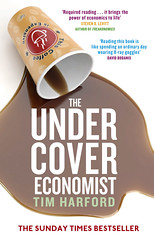
Thoughts on The Undercover Economist

I've just finished The Undercover Economist by Tim Harford. I'd definitely recommend it to anyone who is interested in learning (or refreshing their memory) about the fundamentals of economics. He manages to liven things up with interesting examples and writes in a very straight-forward, readable way. There were a couple of really interesting things in it which I thought were worth sharing.

The first is that placing a tariff on imports has the exact same effect as taxing your exporters. That seems a little crazy at first, but makes sense when you think about it. In very simple terms, if people in a foreign country buy your good in their currency, then you have to buy one of their goods with that currency (or trade it with a bank or individual who will). If there's a tariff on buying their goods, then your efficient export industry have to pay more to buy foreign goods because of the tariffs on them, in order to protect the inefficient industry that the tariff is designed to protect.

He also explains the reasons underpinning fair trade very well, and gives the lie to many of the myths which surround globalisation.
  • Is it bad for the environment? No.
  • Does it make poor people poorer? No.
  • Do people work in worse conditions than they did before multi nationals arrived. No.
I can't do justice fully to his arguments, you'd have to read the book for that. However, he did use one striking example that addresses it's effect with regard to the second two points; in 1975 China's economy, in spite of holding one sixth of the world's population, was only the size of Belgium's. With a more liberalised economy, they are now the fourth largest exporter in the world. Meanwhile, the isolated, insular economies of North Korea and Zimbabwe continue to expose their people to crippling poverty and autocratic rule.

All that got me thinking about the current Doha round of world trade talks, started in 2002 and currently reaching the make-or-break point in Geneva. In Ireland, we stand to gain in cheaper food and greater spending power by reducing the subsidies which we give to our farmers. But won't it make food more expensive? Mean that there's less at a time of international crisis? Cripple farmers economically?

Not really. There was a striking statistic in Thursday's Irish Times; the average full time farmer in Ireland makes a little over €43,900, about €12,000 more than the average industrial wage. Meanwhile, farmers in poor countries, who are already suffering because we cut our foreign aid (disgracefully) in the recent mini-budget, lose out. Our food would not be more expensive, because we would no longer be spending half the EU's budget subsidising our inefficient farming industry, and could instead spend that money on buying cheaper food from poorer countries, with the added bonus of helping those poor farmers and their countries to develop. If that doesn't happen, it will because of vested interests and not the interests of our countries, international ethicacy or common sense.