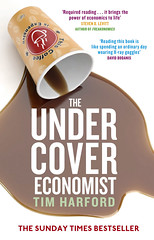
I've just finished
The Undercover Economist by Tim Harford. I'd definitely recommend it to anyone who is interested in learning (or refreshing their memory) about the fundamentals of economics. He manages to liven things up with interesting examples and writes in a very straight-forward, readable way. There were a couple of really interesting things in it which I thought were worth sharing.
The first is that placing a tariff on imports has the exact same effect as taxing your exporters. That seems a little crazy at first, but makes sense when you think about it. In very simple terms, if people in a foreign country buy your good in their currency, then you have to buy one of their goods with that currency (or trade it with a bank or individual who will). If there's a tariff on buying their goods, then your efficient export industry have to pay more to buy foreign goods because of the tariffs on them, in order to protect the inefficient industry that the tariff is designed to protect.
He also explains the reasons underpinning fair trade very well, and gives the lie to many of the myths which surround globalisation.
- Is it bad for the environment? No.
- Does it make poor people poorer? No.
- Do people work in worse conditions than they did before multi nationals arrived. No.
I can't do justice fully to his arguments, you'd have to read the book for that. However, he did use one striking example that addresses it's effect with regard to the second two points; in 1975 China's economy, in spite of holding one sixth of the world's population, was only the size of Belgium's. With a more liberalised economy, they are now the fourth largest exporter in the world. Meanwhile, the isolated, insular economies of North Korea and Zimbabwe continue to expose their people to crippling poverty and autocratic rule.
All that got me thinking about the current Doha round of world trade talks, started in 2002 and currently reaching the make-or-break point in Geneva. In Ireland, we stand to gain in cheaper food and greater spending power by reducing the subsidies which we give to our farmers. But won't it make food more expensive? Mean that there's less at a time of international crisis? Cripple farmers economically?
Not really. There was a striking statistic in Thursday's
Irish Times; the average full time farmer in Ireland makes a little over €43,900, about €12,000 more than the average industrial wage. Meanwhile, farmers in poor countries, who are already suffering because we cut our foreign aid (disgracefully) in the recent mini-budget, lose out. Our food would not be more expensive, because we would no longer be spending half the EU's budget subsidising our inefficient farming industry, and could instead spend that money on buying cheaper food from poorer countries, with the added bonus of helping those poor farmers and their countries to develop. If that doesn't happen, it will because of vested interests and not the interests of our countries, international ethicacy or common sense.